Worth your time?
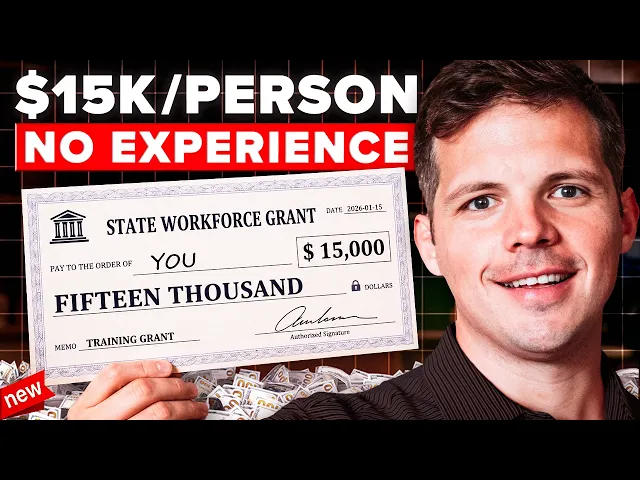
This Grant Pays You $15K/Person (Feels Illegal) by Chris Koerner on The Koerner Office Podcast
 Watch on YouTube
Teaches: useful, practical steps, numbers, and operational advice dominate, but sponsor pushes and repeated high-income claims add hype.
Why this score
- Scored from the transcript, summary, and output signals.
The short version
This video interviews Hector, who built a high-margin trade-school business by selling accredited online vocational courses and capturing state grant reimbursements that pay $5,000-$15,000 per student. He explains how he scaled by treating training like a sales business (CRM, drip campaigns, automation), white-labeling curriculum, minimizing fixed costs by going online, and using Bizzy to incorporate. The conversation covers startup capital (roughly $15k-$30k), pricing examples ($7,500 or $12k-$15k student prices vs $500-$1,500 curriculum cost), and why trades like forklift repair remain largely AI-proof.
What it teaches
- Treat vocational training as a sales product, not a charity. When demand exists, build a predictable funnel (ads, scripts, CRM, drip) and price for unit economics first. Apply this when the certification can be delivered and assessed remotely; avoid it for trades where hands-on time cannot be certified or employers rej
- Use white-label curriculum and partner with operators to separate content delivery from operations. This lets you scale student volume quickly while you validate pricing and market fit. Apply this when you lack subject-matter expertise; avoid it if regulatory rules force proprietary curriculum or strict instructor requ
Key moments
- 1:08Grant payoff: Hector announces a government grant that will pay $5,000 to $15,000 per student, the core business lever.
- 1:33Enrollment pitch revealed: the top sales hook is 'a free grant paying entire tuition,' shifting the purchase barrier.
- 3:58Incorporation shortcut: Hector recommends Busy (busy.com) to form an LLC and track compliance, replacing clunky state websites.
- 5:14Startup reserve guidance: states often require evidence of two to three months operating reserves, estimated $15k-$30k.
- 8:44Scale vs overhead lesson: first-year revenue hit $2.4M but suffered from unnecessary physical overhead; moving online increased profitability.
- 10:18Unit economics example: student price ranges cited ($12,000-$15,000) versus curriculum acquisition costs (as low as $500 or $1,500), illustrating 70%-90% margins.
Skip the video. Keep the lesson.
More scored videos