Hype Check · Nate Herk | AI Automation
Worth your time?
I Built Another Andrej Karpathy Using Claude by Nate Herk | AI Automation
 Watch on YouTube
Hype score · lower is better
26/100
Useful but promotional
Teaches: you get a practical, screen-shown walkthrough with prompts, a wiki build, and runnable tests to create a Karpathy-style Claude agent.
Receipts
Why this score
- Scored from the transcript, summary, and output signals.
Title deliveredtitle promises a Karpathy-like agent; the video shows four steps, prompts, and live tests that build that agent
Skip the video
The short version
Kept by Clip'd
Nate shows how to turn Andrej Karpathy's public writing, talks, and code into a Claude agent that teaches like him. The workflow pulls raw sources, compiles them into an LLM-backed wiki, extracts seven explicit teaching rules into a sub-agent and skill, enforces a run-and-verify hook so code is executed before answers, and then tests the agent by building and explaining a byte-pair tokenizer.
Keep the lesson
What it teaches
- Convert raw expert material into a structured, queryable knowledge base (an LLM wiki) before asking an LLM to 'be' that expert. Apply this when you need consistent, auditable expert reasoning from models; avoid it when material is proprietary/unavailable or freshness matters more than provenance. The common mistake is
- Enforce execution and verification as part of the agent's workflow, not an optional step. Use a run-gate or test hook when the agent outputs working code or empirical claims; skip heavy verification only when speed matters and the cost of error is trivial. The common mistake is trusting model assertions without automat
- Capture the expert's heuristics as explicit rules tethered to quotes and sources, then use them to grade outputs. Apply this to preserve a style or evaluation standard across tasks (teaching, code reviews, design choices); do not overfit when an expert's rules conflict with new domain constraints. People often skip enc
Jump straight there
Key moments
- 0:01Bold project claim: Nate says he 'turned one of the biggest minds in AI into a Claude agent', sets the video's ambitious scope and hook.
- 3:09Data collection tools explained: lists YouTube Transcript API, yt-dlp for captions, and twitterapi.io for X, shows concrete, low-cost tooling for building the source corpus.
- 3:44Scale of sources: 'one raw folder with one subfolder per source, and over 700,000 words', explains the data volume that the wiki must manage.
- 4:04Karpathy's LLM wiki method: using an LLM to compile raw sources into linked wiki pages and an index, the core organization model that makes expert thinking queryable.
- 5:51The seven rules extracted: a compact rule set (e.g., build smallest version, predict then run, show the wrong version) that defines the agent's behavior and evaluation.
- 6:50Two output files: a sub-agent (mini Claude with its own instructions and memory) and a skill that exposes a {slash} Karpathy-teach command, shows practical deployment artifacts.
Clip'd
Skip the video. Keep the lesson.
The Hype Board
More scored videos

61/100 · Hype heavyGemini 4 and Muse Wonder Are HUGE… But Claude DESTROYS ThemRiley Brown

34/100 · Useful but promotionalCopy This Grok Bot Prompt, It'll Blow Up Your X AccountJacob C. Edmunds
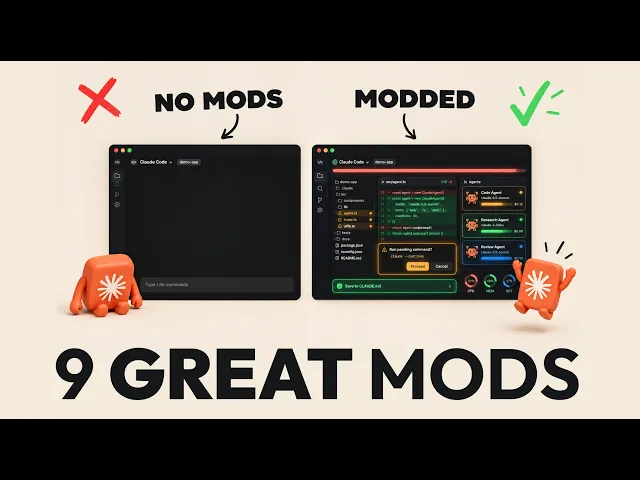
37/100 · Useful but promotional9 NEW Claude Mods that can truly change how you workJay E | RoboNuggets

47/100 · Useful but promotionalI built myself a GAME CHANGING app with Opus 5.5: It's not what you thinkClearmud

28/100 · Useful but promotionalyou need to try Paperclip RIGHT NOW!NetworkChuck
44/100 · Useful but promotional8 Jev Use Cases That Feel Like CheatingMatthew Berman