Hype Check · Ras Mic
Worth your time?
The 3 skills I use everyday (Agentic Engineering) by Ras Mic
 Watch on YouTube
Hype score · lower is better
28/100
Useful but promotional
Teaches: a practical walkthrough of three agent skills and agent.md usage, with a brief paid-sandbox promo tacked on.
Receipts
Why this score
- 2:26Shows concrete tokenizer numbers (944 vs 53 tokens) and explains why skills save context, which increases usable, actionable detail and raises substance and proof.
- 5:38Delivers a sponsor-style CTA with a $100 credit for Daytona, which is a direct paid promotion and raises pitch pressure relative to the tutorial content.
- 9:57Discloses that Greile sponsors some videos while saying this one is not, which adds transparency and lowers claim inflation despite tool endorsements.
- 11:02Explains the GP loop workflow (pull PR, push a fix, re-run until 5/5) and shows runtime details (19 minutes), giving a clear, repeatable procedure and strengthening substance and proof.
Title deliveredtitle promises 3, video covers 3 (code-structure, GP loop, code-simplifier) and explains agentic engineering usage
Skip the video
The short version
Kept by Clip'd
The creator explains the three agentic skills he uses daily (a code-structure skill, a GP loop code-review loop, and a Claude code-simplifier) and why he pairs them with a persistent agents.mmd file. He contrasts skills, which inject only metadata (name + description) at runtime to save tokens, with agents.mmd files that are loaded every turn for policies and workflows. He demos token savings, a Daytona sandbox test, and the GP loop that iterates until a 5/5 review score.
Keep the lesson
What it teaches
- Load only what the model needs into its context. When you need occasional behavior or utilities, publish them as skills so the agent receives only the name and description until invocation. Apply this when you face context-window limits or want predictable token costs. Do not use skills for policies or rules the agent
- Treat agents.mmd as a policy layer, not a toolbox. Put branching rules, deployment workflows, and always-on permissions in agents.mmd so the agent enforces team conventions every conversation. Use it when you need consistent behavior across turns; avoid stuffing it with large code dumps or rarely used utilities.
- Build feedback loops that run until a measurable quality metric is met. The GP loop shows how to automate review->fix->re-review until a target (5/5) is reached. Use this for code quality and security checks; do not replace human judgment for ambiguous design decisions.
Jump straight there
Key moments
- 1:12Skill anatomy: the creator defines skills as metadata (name, description) plus instructions, highlighting a repeatable file structure.
- 2:41Token cost example: loading a full skill markdown into context costs about 944 tokens, demonstrating why injecting less matters.
- 3:04Metadata-only injection: the skill approach drops context cost to 53 tokens by injecting only name and description.
- 4:35Daytona benchmark claim: "one thing that you see in commonality is Daytona is number one," supporting the choice of Daytona as the sandbox provider.
- 11:17GP loop behavior: the GP loop reads a PR, applies fixes, waits for a new review, and repeats until the review reaches a five out of five.
Lines worth keeping
Quotes
- The only thing injected in the context of the AI agent of the model when you're using skills is the name and the description.3:09
- When you flip through all the different benchmarks, all the different tests, one thing that you see in commonality is Daytona is number one.4:29
- Skills are on a need to know basis.12:34
Clip'd
Skip the video. Keep the lesson.
The Hype Board
More scored videos

61/100 · Hype heavyGemini 4 and Muse Wonder Are HUGE… But Claude DESTROYS ThemRiley Brown
34/100 · Useful but promotionalCopy This Grok Bot Prompt, It'll Blow Up Your X AccountJacob C. Edmunds
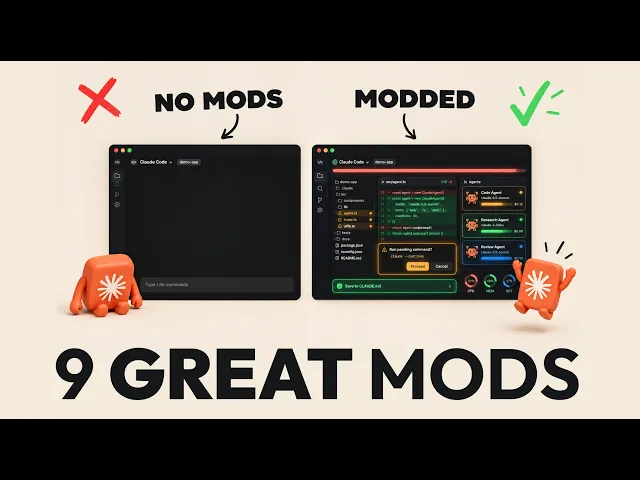
37/100 · Useful but promotional9 NEW Claude Mods that can truly change how you workJay E | RoboNuggets

47/100 · Useful but promotionalI built myself a GAME CHANGING app with Opus 5.5: It's not what you thinkClearmud

26/100 · Useful but promotionalI Built Another Andrej Karpathy Using ClaudeNate Herk | AI Automation

28/100 · Useful but promotionalyou need to try Paperclip RIGHT NOW!NetworkChuck