Hype Check · Matt Wolfe
Worth your time?
Testing the 2 BIGGEST AI Website Builders by Matt Wolfe
 Watch on YouTube
Hype score · lower is better
35/100
Useful but promotional
Fast, useful comparison that teaches workflows and tradeoffs while ending with a light promotional plug for Framer.
Receipts
Why this score
- 0:31Framer's agent builds the site inside Framer's design canvas and generates sections, layouts, animations, and responsive pages, which shows a concrete end-to-end workflow and raises substance.
- 0:41The host says you can ask the agent to fix elements, manually redesign the hero, change typography, and optimize SEO metadata, which gives specific, usable actions rather than vague claims.
- 1:12Claude outputs a design as code that still needs another platform to become a live site, an explicit tradeoff that reduces proof of a single-platform solution but adds useful comparison detail.
- 1:32The video closes with a direct endorsement, 'Framer's AI agents do a great job' and 'check out Framer', a soft self-promo that increases pitch pressure without heavy hard-selling.
Title deliveredtitle promises 2, video covers 2 (Framer and Claude) and compares their output and workflow
Skip the video
The short version
Kept by Clip'd
The creator compared two AI website builders, Framer (with new Framer agents) and Claude Design, by asking each to build a landing page for "Midjourney's new full body scanner product." Framer built and let him edit, branch, and publish the site inside its design canvas, while Claude produced design-as-code that still needed to be exported and hosted elsewhere. The video highlights pros and cons: Framer gives an end-to-end, in-place workflow for launching sites fast; Claude generates clean code but requires extra steps to turn that code into a live site.
Keep the lesson
What it teaches
- Use the integrated-vs-modular decision model: pick an integrated platform (Framer) when your priority is speed to launch, in-place iteration, and simple publishing. Choose a modular/code-first tool (Claude) when you need portability of code, custom backend integration, or a specific tech stack. Common mistake: confusin
- Treat AI site builders as workflow tools, not magic shortcuts: the real savings come from reducing context switching between design, copy, and deployment. Apply this when you need fast client reviews and versioning. Do not apply this mindset when the project requires deep backend customization or unique hosting constra
Jump straight there
Key moments
- 0:23Framer agents can operate directly on a live website: this is the core product capability that lets the AI edit the actual site rather than only exporting assets or code.
- 0:31Agent builds inside Framer's design canvas: shows the AI creating sections, layouts, animations, and responsive pages where the final site lives, enabling immediate visual iteration.
- 0:52Ability to optimize SEO metadata and tweak design: demonstrates that the workflow includes practical publishing concerns, not just visuals.
- 0:54Branching and version comparison: highlights a professional workflow, create alternatives and only publish the chosen version.
- 1:12Claude outputs design as code requiring a separate production step: key trade-off, code portability versus extra work to host and publish.
Lines worth keeping
Quotes
- Framer agents that can operate directly on a live website.0:23
- Claude created the design in code, then you still have to take that output and turn it into a production website in another platform to launch it.1:12
- With Framer, design editing, AI collaboration, and publishing, they all happen in this one place.1:18
- So, for client sites or for your own business, check out Framer.1:35
Clip'd
Skip the video. Keep the lesson.
The Hype Board
More scored videos

61/100 · Hype heavyGemini 4 and Muse Wonder Are HUGE… But Claude DESTROYS ThemRiley Brown
34/100 · Useful but promotionalCopy This Grok Bot Prompt, It'll Blow Up Your X AccountJacob C. Edmunds
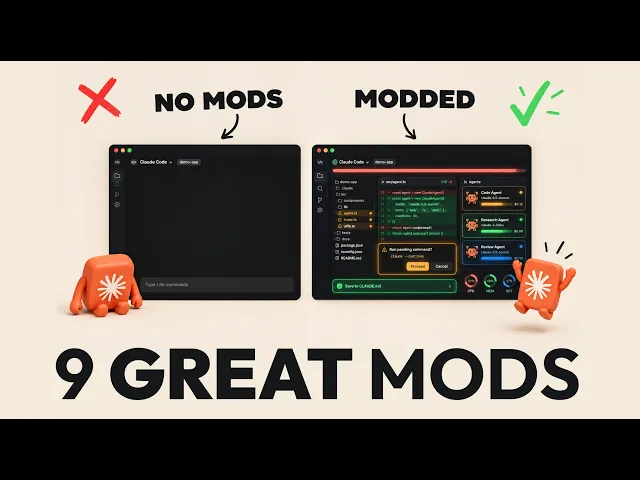
37/100 · Useful but promotional9 NEW Claude Mods that can truly change how you workJay E | RoboNuggets

47/100 · Useful but promotionalI built myself a GAME CHANGING app with Opus 5.5: It's not what you thinkClearmud

26/100 · Useful but promotionalI Built Another Andrej Karpathy Using ClaudeNate Herk | AI Automation

28/100 · Useful but promotionalyou need to try Paperclip RIGHT NOW!NetworkChuck