Hype Check · Larue
Worth your time?
Stop Prompting Codex. Write Loops Instead. by Larue
 Watch on YouTube
Hype score · lower is better
23/100
Useful / Authentic
Teaches the concept and practical steps for building loops, with useful checklists and implementation notes, but it offers little demonstrable proof or live results.
Receipts
Why this score
- 0:00Opens with quotes from Peter Steinberger and Boris Cherny claiming they write loops instead of prompting; that adds expert context and raises credibility so the topic feels grounded.
- 1:05Defines a loop as a repeating prompt with a trigger and a goal and contrasts it with single prompts; this gives a clear, actionable definition that increases substance.
- 2:11Lists four decision questions (waste, repeatability, clear done, verification tools) to decide when to use loops; that checklist is practical and directly usable.
- 3:06Shows how to create a basic Codex loop with /goal and describes memory, verifier, and stop-condition layers; the steps are concrete but the video gives no live runs or results, so proof remains limited.
Title deliveredTitle promises you should write loops instead of prompting Codex; the video explains what loops are and shows how to create one with /goal plus supporting layers, so it delivers.
Skip the video
The short version
Kept by Clip'd
This video explains why top AI engineers are replacing single prompts with autonomous "loops" that run until a goal is met. It defines a loop (trigger + goal), gives decision rules for when to use one, and shows how to create a basic loop in Codex plus three practical layers to make loops reliable: memory, a verifier, and a stop condition.
Keep the lesson
What it teaches
- Design for verifiability and cost control. Use loops when the task repeats, has a clear yes/no completion test, and the agent can run checks itself. Add memory so the loop learns across runs, and add a hard stop or budget to avoid runaway costs. Do not use loops for purely subjective tasks or when you cannot supply an
- Treat the loop as an automation + CI system, not a single prompt. The mental model is the feedback loop: trigger -> agent action -> verifier -> memory -> next action. Apply this when automating bug fixes, dependency updates, or test-driven workflows; avoid it for one-off creative edits or aesthetics where human judgmen
- Prioritize tooling and observability. The most common mistake is launching loops without giving the agent the tools to check outcomes or without saving history, which causes repeated failures and wasted tokens. Connect the loop to logs, browser checks, or test suites so it has objective signals to stop or change strate
Jump straight there
Key moments
- 0:00Why this moment matters: The video opens with clear endorsements from Peter Steinberger and Boris Cherny, framing loops as the new best practice for coding agents.
- 0:44Why this moment matters: The presenter defines a loop precisely as a prompt that repeats until a goal is complete, drawing a sharp distinction from one-off prompting.
- 1:05Why this moment matters: The minimal specification, "a trigger and a goal", gives you a low-friction entry point to build your first autonomous agent.
- 2:07Why this moment matters: The four decision questions (waste tolerance, repetition, clear done condition, available verification tools) provide a practical checklist to avoid costly misuse.
- 3:08Why this moment matters: The concrete Codex example (/goal update every outdated dependency, then make sure the build still passes) shows how to translate the idea into a runnable command.
- 3:32Why this moment matters: Introducing memory stops repeating failures; the Addy Osmani line crystallizes the concept into a reusable engineering principle.
Lines worth keeping
Quotes
- You shouldn't be prompting coding agents anymore. You should be designing loops that prompt your agents.0:00
- I don't prompt Claude anymore. I have loops that are running. They're the ones that are prompting Claude and kind of figuring out what to do. My job is to write loops.0:35
- For a basic loop, you only need two things: a trigger and a goal.1:05
- The agent forgets, the repo doesn't.3:49
Clip'd
Skip the video. Keep the lesson.
The Hype Board
More scored videos

61/100 · Hype heavyGemini 4 and Muse Wonder Are HUGE… But Claude DESTROYS ThemRiley Brown
34/100 · Useful but promotionalCopy This Grok Bot Prompt, It'll Blow Up Your X AccountJacob C. Edmunds
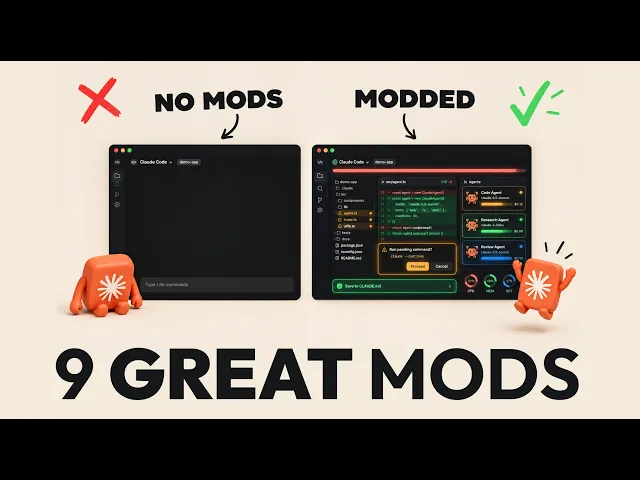
37/100 · Useful but promotional9 NEW Claude Mods that can truly change how you workJay E | RoboNuggets

47/100 · Useful but promotionalI built myself a GAME CHANGING app with Opus 5.5: It's not what you thinkClearmud

26/100 · Useful but promotionalI Built Another Andrej Karpathy Using ClaudeNate Herk | AI Automation

28/100 · Useful but promotionalyou need to try Paperclip RIGHT NOW!NetworkChuck