Hype Check · Alex Finn
Worth your time?
OpenClaw + Obsidian gives you super powers by Alex Finn
 Watch on YouTube
Hype score · lower is better
32/100
Useful / Authentic
Educational and practical with a soft promotional plug; the video teaches a reproducible system rather than just selling it.
Receipts
Why this score
- Provides a concrete, copy-paste prompt and a reproducible setup to test.
- Shows specific validation steps and a real benefit claim (no compactions noticed).
- Includes a community/course plug (Vibe Coding Academy) but the core method and prompt are given free.
Skip the video
The short version
Kept by Clip'd
Alex shows how to add an Obsidian vault as a third memory layer for OpenClaw (or Hermes) so your agent keeps context across compactions, finds old projects on demand, and shares memory between multiple agents. He explains the four-layer memory model, demonstrates the benefits (fewer forgotten threads, memory-on-demand, shared agent workspace), and gives a copy-paste prompt to wire the system into your agent plus a validation check.
Keep the lesson
What it teaches
- Use an external, indexed file store as a selective context layer for agents. When an agent's built-in prompt memory or session log becomes noisy or gets compacted, load targeted files (daily logs, project notes) at session start or on demand to restore context without inflating prompts. Don't dump your whole vault into
- Treat agent memory like a cache hierarchy: keep tiny, always-included facts in the prompt (built-in memory), keep policy/rules in a separate rules file (agents.mmd and soul.md), and put long-form, rarely-needed context in a document store (Obsidian) that the agent queries as needed. Apply this when you need persistence
- Share a small, focused workspace between agents to let specialized agents hand off work. Use a shared folder for produced artifacts and summaries, not raw session transcripts. The common mistake is treating the shared folder as a dumping ground instead of a curated interface; it should contain actionable summaries and
Jump straight there
Key moments
- 0:00Bold problem statement: "OpenClaw's memory sucks." Sets the video's motivation and hooks viewers who experience the same.
- 1:34Tool choice explained: Declares Obsidian + markdown as the readable file format agents already use, justifying the approach.
- 3:58Architectural change: Announces adding a third layer (Obsidian vault) that is not auto-injected, a pivotal design decision for scalable memory.
- 5:16Evidence claim: "I haven't noticed a single compaction since putting in this system." A measurable benefit claim viewers can test.
- 6:10Cross-agent collaboration: Shows the agent-shared directory pattern that lets Hermes and OpenClaw hand off work.
- 7:48Practical delivery: Offers a copy-paste prompt that automates building the system, lowering the barrier to replicate.
Clip'd
Skip the video. Keep the lesson.
The Hype Board
More scored videos

61/100 · Hype heavyGemini 4 and Muse Wonder Are HUGE… But Claude DESTROYS ThemRiley Brown
34/100 · Useful but promotionalCopy This Grok Bot Prompt, It'll Blow Up Your X AccountJacob C. Edmunds
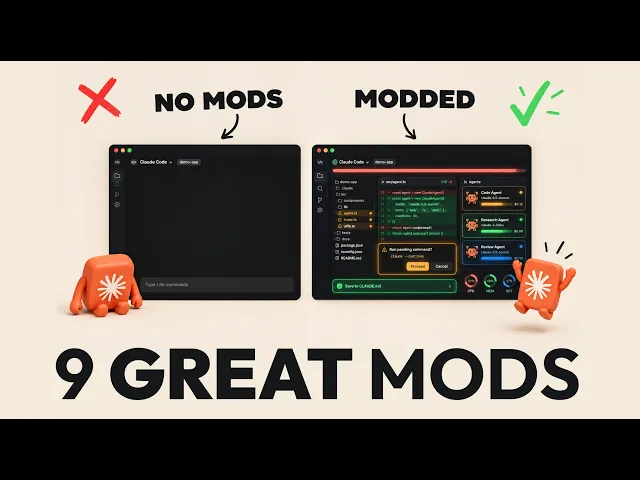
37/100 · Useful but promotional9 NEW Claude Mods that can truly change how you workJay E | RoboNuggets

47/100 · Useful but promotionalI built myself a GAME CHANGING app with Opus 5.5: It's not what you thinkClearmud

26/100 · Useful but promotionalI Built Another Andrej Karpathy Using ClaudeNate Herk | AI Automation

28/100 · Useful but promotionalyou need to try Paperclip RIGHT NOW!NetworkChuck