Worth your time?
I Built an AI Content Studio with 5 Hermes Agents (Step-by-Step Guide) by Komputer Mechanic
 Watch on YouTube
Teaches: a deep, step-by-step technical build with live demos and working proof, plus a few paid plugs and a sponsor.
Why this score
- 0:36At 0:36 the host offers an 'auto installer' to skip the 4+ hour build, a paid convenience that lowers the free-value ratio (raises pitchPressure).
- 33:14At 33:14 there is a formal sponsor read for Sudalis AI, an explicit ad break that counts as selling even though it does not hide the tutorial content.
- 37:00At 37:00 the creator pitches a $10/month membership and gated prompt/templates, a clear paid upsell that shifts some useful material behind payment.
- 1:34:35At 1:34:35 the creator asks for likes/subscribes (channel housekeeping), which is low-pressure and does not meaningfully change the score.
- 1:39:34At 1:39:34 the video shows a live post published to Instagram from the demo, concrete proof that backs several implementation claims (raises proof).
The short version
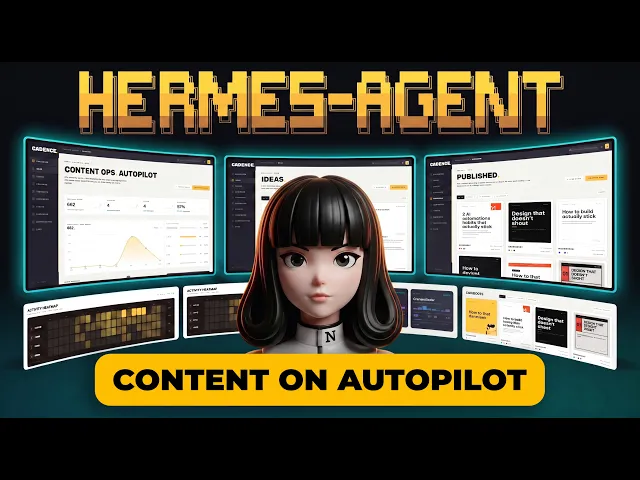
Larry builds 'Cadence', a content operations studio that runs research, writing, design, rendering, and publishing using four persistent Hermes agents (Atlas, Vera, Kite, Orion) plus an orchestrator. The system uses HTML templates rendered by a headless browser so edits cost nothing, logs every agent action into an SQLite run table for transparency, and exposes a dashboard plus Telegram controls to run the pipeline end-to-end (idea → carousel → Buffer → Instagram). The video walks through VPS choices, Hermes install, Telegram bot/group/topic binding, per-agent memory and role boundaries, API key wiring (Perplexity, imageBB, Buffer), and a full smoke-tested publish flow.
What it teaches
- Design-by-code over image-by-AI: Render social posts from HTML templates and export them with a headless browser. Apply this when you need frequent, iterative edits and predictable visual layout; avoid it if you need photorealistic generative imagery. The common mistake is treating image models as the editing layer, wh
- Agent ops as modular roles with strict boundaries: Give each agent its own persistent profile, memory file, and role definition, and log every action to a central run table. Use this when you run multi-agent pipelines that need auditability and predictable handoffs; avoid shared-memory designs that bloat token usage an
Key moments
- 0:00Hook demo: Shows the whole pipeline in one short sequence so viewers immediately see the end-to-end value of the system.
- 1:58Template vs image model claim: Cadence renders slides from HTML templates (not image-generation models), enabling unlimited free edits per slide.
- 2:15Cost model insight: "Meaning you have unlimited revisions with zero cost per slide", reframes where your recurring costs go (words/models vs images).
- 21:41One-line Hermes installer: The installer bundles all dependencies so you can bootstrap the Hermes gateway quickly on a VPS.
- 24:01Telegram integration: Creating a Telegram bot and group topics turns Hermes into a usable, chat-first control plane for agents.
- 44:42Persistent agent creation confirmed: Orchestrator creates the five persistent Hermes profiles (orchestrator + four specialists) and commits their soul.md to memory.
Skip the video. Keep the lesson.
More scored videos