Hype Check · Clearmud
Worth your time?
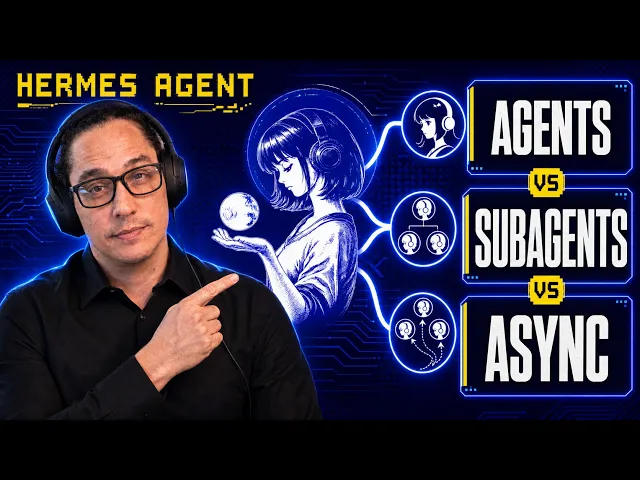
Hermes Agent Tutorial: Agent vs Sub-Agent vs Async (For Beginners) by Clearmud
 Watch on YouTube
Hype score · lower is better
15/100
Useful / Authentic
Teaches, a focused beginner tutorial that explains differences, gives templates and practical prompts, and does not push a paid product.
Receipts
Why this score
- Scored from the transcript, summary, and output signals.
Title deliveredTitle promises a Hermes agent tutorial on agent vs sub-agent vs async; the video defines each, provides side-by-side comparisons, contracts, and example prompts as promised.
Skip the video
The short version
Kept by Clip'd
This video explains the practical differences between Hermes agent profiles, sub-agents, and asynchronous/background tasks. It defines each concept (ownership, isolation, lifetime), compares identity, context, and execution behavior, and gives concrete prompts and patterns for when to create profiles, spawn sub-agents in parallel, or schedule durable background work like crons or Kanban tasks. The creator also lists common delegation failures and a short checklist to decide which model to use.
Keep the lesson
What it teaches
- Map responsibilities to duration and scope. Use a full Hermes profile when a role needs durable identity, memory, and judgment (long-lived ownership). Use a sub-agent when you need isolated, parallel specialist work with only the parent's context. Use async/background when tasks must outlive the current interaction or
- Design multi-agent flows like software processes, not loose requests. Treat the parent profile as the orchestrator that owns the goal and review gate; give child runs the smallest useful packet and tools. Avoid leaving the child responsible for scope or return format. This model applies to delegating work between peopl
- Prefer explicit execution mechanisms over vague language. Saying "in parallel" or invoking "/background" or a cron maps intent to concrete Hermes infrastructure. The mistake is relying on implied behavior (asking an agent to "research this") instead of choosing parallelism or durability explicitly.
Jump straight there
Key moments
- 0:39Clear framing: "Agent is ownership, sub agent is isolation, and async is lifetime", condenses the three core design decisions into one memorable triad.
- 1:08Profile ownership explained: New profiles become agents and each profile owns its config, soul MD, memory, sessions, skills, crons, tools, and state, shows what 'agent' actually contains.
- 1:25Sub-agent behavior: Sub-agents start fresh with only the parent goal and context, and get their own conversation, terminal session, and selected tool sets, explains isolation and bounded scope.
- 1:57Async clarification: "There's technically no such thing" as an asynchronous agent; background work are tasks, not new agents, prevents a common category error.
- 2:13Async mechanisms listed: Use of /background, cron, Kanban, and terminal background to keep work outside the live turn, practical execution options.
- 5:48Decision checklist introduced: Four questions to ask before spawning an agent/sub-agent/async task, provides a repeatable decision model.
Clip'd
Skip the video. Keep the lesson.
The Hype Board
More scored videos

61/100 · Hype heavyGemini 4 and Muse Wonder Are HUGE… But Claude DESTROYS ThemRiley Brown
34/100 · Useful but promotionalCopy This Grok Bot Prompt, It'll Blow Up Your X AccountJacob C. Edmunds
37/100 · Useful but promotional9 NEW Claude Mods that can truly change how you workJay E | RoboNuggets

47/100 · Useful but promotionalI built myself a GAME CHANGING app with Opus 5.5: It's not what you thinkClearmud

26/100 · Useful but promotionalI Built Another Andrej Karpathy Using ClaudeNate Herk | AI Automation

28/100 · Useful but promotionalyou need to try Paperclip RIGHT NOW!NetworkChuck