Hype Check · Greg Isenberg
Worth your time?
Easily build agentic workflows with Hyperagent by Greg Isenberg
 Watch on YouTube
Hype score · lower is better
36/100
Useful but promotional
Teaches at a high level: it outlines a workable Hyperagent workflow but stops short of a full, actionable tutorial.
Receipts
Why this score
- 0:06Explains the first concrete step: build a "skill" by describing your use case and setting quality standards. That raises substance because it gives a tangible starting action, but the explanation stays high-level with no walkthrough.
- 0:13Adds an LLM 'judge' that scores outputs against standards, which describes a clear quality-control pattern and improves usefulness, but the video shows no examples of scores or configuration so proof remains weak.
- 0:32Lists a chain of agents (market research, Reddit validation, competitive mapping) and says it produces a prototype, marketing site, and ad creative. The range boosts perceived utility, but the clip provides no inputs, outputs, or demo, so substance is shallow.
- 0:51Claims the whole workflow costs about $35 and compares it to an Uber Eats order. That is a concrete dollar claim (counted once in the transcript) but the video gives no breakdown or evidence, which increases claim inflation and lowers proof.
Title partialTitle promises you can "easily build" agentic workflows; the video outlines the workflow and cost but provides no step-by-step demo or configuration details.
Skip the video
The short version
Kept by Clip'd
The video demos a low-cost agent pipeline built in Hyper Agent that turns one brief into a sequence of specialist agents: market research, Reddit demand validation, competitor mapping, and product assets. You build a skill with clear quality standards, attach an LLM judge that scores every output against those standards, then paste a brief to trigger the chain. The result: prototypes, a marketing site, and ad creative delivered while keeping total token spend around $35.
Keep the lesson
What it teaches
- Use a dedicated judge component to enforce quality before human review. Apply this when you need consistent output standards across automated steps, such as content, research, or prototype generation. Do not use it as a creative generator itself; its role is evaluation. The common mistake is leaving quality checks to h
- Break complex workflows into specialist agents that run in sequence from a single brief. Use this when a task naturally splits into research, validation, and asset creation, because specialists scale and are easier to tune. Avoid this pattern when the task requires unpredictable human creativity or context that agents
Jump straight there
Key moments
- 0:00Cost claim: positions the workflow as inexpensive and immediately compelling by comparing to an Uber Eats order.
- 0:06Skill + standards: establishes the core input, a skill on Hyper Agent defined by your use case and explicit quality standards.
- 0:13Judge LLM introduced: the critical control that enforces standards by scoring every output before it reaches you.
- 0:28One-brief trigger: describes how pasting a single brief launches a chain of agents, turning one input into multiple deliverables.
- 0:46End-to-end outputs: lists concrete deliverables, working prototype, marketing site, ad creative, showing practical value from the pipeline.
- 0:51Token spend total: gives a concrete cost metric, about $35, which sets expectations for budget and efficiency.
Clip'd
Skip the video. Keep the lesson.
The Hype Board
More scored videos

61/100 · Hype heavyGemini 4 and Muse Wonder Are HUGE… But Claude DESTROYS ThemRiley Brown

34/100 · Useful but promotionalCopy This Grok Bot Prompt, It'll Blow Up Your X AccountJacob C. Edmunds
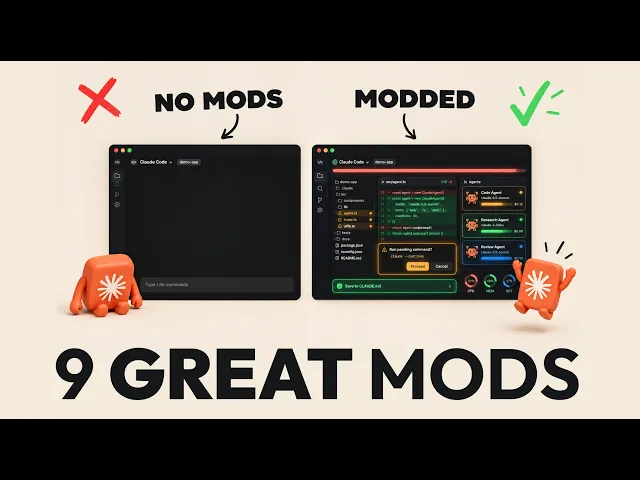
37/100 · Useful but promotional9 NEW Claude Mods that can truly change how you workJay E | RoboNuggets

47/100 · Useful but promotionalI built myself a GAME CHANGING app with Opus 5.5: It's not what you thinkClearmud

26/100 · Useful but promotionalI Built Another Andrej Karpathy Using ClaudeNate Herk | AI Automation

28/100 · Useful but promotionalyou need to try Paperclip RIGHT NOW!NetworkChuck