Hype Check · Clearmud
Worth your time?
Can I Actually Build GTA VI with Claude Opus 5? by Clearmud
 Watch on YouTube
Hype score · lower is better
25/100
Useful / Authentic
This is primarily a hands‑on demo that teaches by showing prompts, live outputs, and measurable costs while also entertaining through stream banter.
Receipts
Why this score
- Scored from the transcript, summary, and output signals.
Title partialTitle asks if Claude can build GTA VI; the stream attempts a GTA‑style prototype and Lisbon map and shows playable bits, but it stops short of a full, production GTA VI.
Skip the video
The short version
Kept by Clip'd
The livestream pivots mid-stream to test Claude Opus 5, running playful and practical prompts: a tongue-in-cheek request to "build GTA 6" and a serious benchmark to create a 3D always-on agent activity dashboard that connects to OpenClaw and Hermes gateways. The creator demos Opus 5 in real time, tracks estimated API costs with an open-sourced model meter, compares Opus to other frontier models, notes strengths and remaining gaps (geometry, navigation), and outlines how he'd integrate outputs into production pipelines.
Keep the lesson
What it teaches
- Use pragmatic task scoping and integration goals, not headline demos. When testing a new large model, define the real product outcome you need (for example, an always-on dashboard that connects to your gateway) and evaluate the model by whether it produces usable components you can integrate. Don’t apply this when you
- Balance generation and verification by splitting responsibilities across models and tools. Generate UI, text, or assets with a strong creative model (Opus/Fable) and hand off code quality or production hardening to a reliable engineering model (GPT-5.6 Soul in the host’s workflow). Apply this whenever you need both cre
- Track cost and behavior continuously rather than trusting one-time outputs. Metering (local OOTH tokens or estimated API costs) and quick sanity checks (hallucination rates, endpoint fetch tests) let you decide whether to iterate, hand off, or stop. This works when you control usage; it is less useful when you only do
Jump straight there
Key moments
- 0:30Claimed scope limits and humor: the host reads Opus's comedic-but-practical refusal to guarantee a flawless GTA 6 build, setting realistic expectations for LLM-generated projects
- 3:31Model meter open-source mention: link to Clear Mud's GitHub and explanation that the meter uses OOTH tokens to estimate API costs
- 15:07Benchmark prompt introduced: requests a 3D activity dashboard that connects to OpenClaw and Hermes with doc references (docs.openclaw.ai and Hermes research-docs)
- 22:22Early cost snapshot: the Opus session shows about $29 in estimated API costs for the running demo
- 31:56Hallucination metric note: the stream references a 50% hallucination stat while discussing model reliability and benchmarks
- 1:05:45Practical verdict: after testing, the host declares Opus 5 "room for improvements, but so far my favorite," highlighting functional over visual wins
Lines worth keeping
Quotes
- Build me GTA 6. Make no mistakes. I can't build GTA 6. That's a $2 billion project with 2,000 developers over a decade, and no amount of AI assistance changes that0:30
- I'd like you to build a 3D activity dashboard.15:07
- an always on agent activity dashboard that connects to your OpenClaw and Hermes agent gateways.1:06:08
Clip'd
Skip the video. Keep the lesson.
The Hype Board
More scored videos

61/100 · Hype heavyGemini 4 and Muse Wonder Are HUGE… But Claude DESTROYS ThemRiley Brown
34/100 · Useful but promotionalCopy This Grok Bot Prompt, It'll Blow Up Your X AccountJacob C. Edmunds
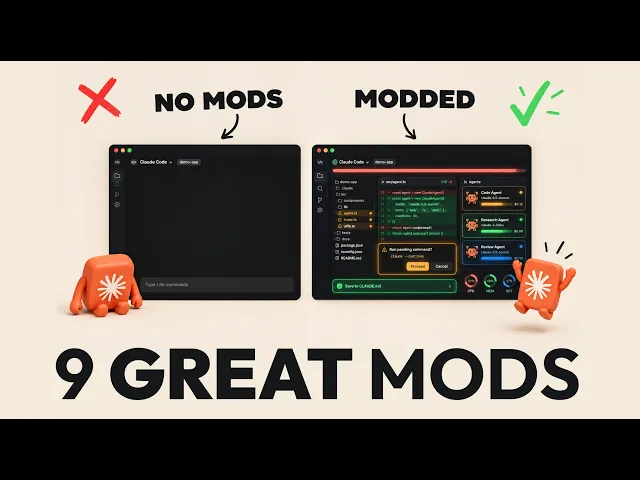
37/100 · Useful but promotional9 NEW Claude Mods that can truly change how you workJay E | RoboNuggets

47/100 · Useful but promotionalI built myself a GAME CHANGING app with Opus 5.5: It's not what you thinkClearmud

26/100 · Useful but promotionalI Built Another Andrej Karpathy Using ClaudeNate Herk | AI Automation

28/100 · Useful but promotionalyou need to try Paperclip RIGHT NOW!NetworkChuck