Hype Check · Cole Medin
Worth your time?
11 Tiny Coding Agent Fixes With A Stupid Amount Of Payoff by Cole Medin
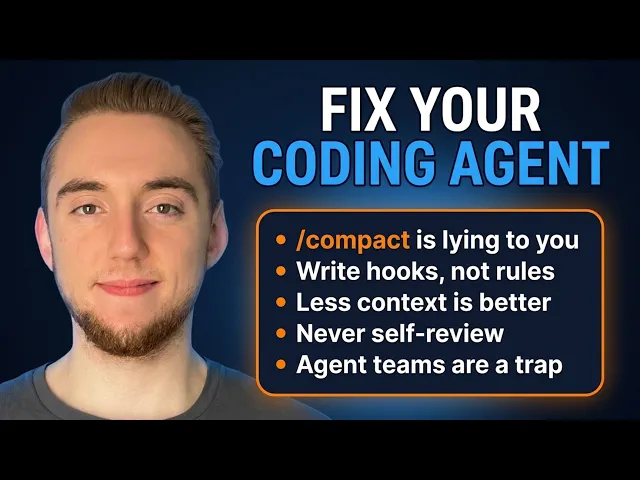 Watch on YouTube
Hype score · lower is better
45/100
Useful but promotional
Teaches: the video delivers practical, actionable tips more than a sales pitch, though several claims lack rigorous on-screen proof.
Receipts
Why this score
- Scored from the transcript, summary, and output signals.
Title deliveredtitle promises 11 fixes, video covers 11 distinct tips with concise explanations
Skip the video
The short version
Kept by Clip'd
Cole walks through 11 practical tweaks that make coding agents more reliable without rebuilding your workflow. He focuses on reducing assumptions, preventing stale rules, avoiding brittle conversation compression, using deterministic hooks (especially for tests), managing token usage from subagents, and treating validation as an integrated system.
Keep the lesson
What it teaches
- Manage brittle state and non-determinism by separating probabilistic guidance (rules) from deterministic guarantees (hooks). Use hooks when you need a hard guarantee, for example running your test suite after an implementation. Don't overuse hooks for things that should remain flexible, and avoid the common mistake of
- Treat conversational context as fragile: long, correction-filled chats accumulate biases and errors. When a thread starts failing, stop trying to force-fix it; instead, write a concise handoff and start a fresh session. The common error is trying to muscle through a tainted conversation or switching models midtask, whi
- Design validation as an integrated system, not a final checkbox. Plan the validation harness, unit and integration tests, and edge-case checks before you ask an agent to write code. The frequent mistake is doing validation ad hoc after implementation, which makes fixes expensive and unreliable.
Jump straight there
Key moments
- 1:29Why specificity matters: 'Write for the agent, not the human' establishes the core rule that reduces agent assumptions and prevents errors.
- 3:26Rule-drift statistic: He cites a study that about one in four repositories with AI rules have stale rules, highlighting maintenance risk.
- 4:39Slash-compact failure rate: A cited study shows only ~10% of specific conversation details survive compaction, which explains why compacting loses critical context.
- 6:31Deterministic hooks demo point: Running tests via a hook after the agent signals completion guarantees test execution and forces remediation on failure.
- 10:32Token/parallelism cost example: '/usage' shows 39% of weekly usage came from running four+ sessions in parallel, illustrating how subagents drive costs.
- 11:43Tainted conversation warning: Switching models mid-conversation won't fix trajectory biases; start a fresh session with a handoff instead.
Clip'd
Skip the video. Keep the lesson.
The Hype Board
More scored videos

61/100 · Hype heavyGemini 4 and Muse Wonder Are HUGE… But Claude DESTROYS ThemRiley Brown

34/100 · Useful but promotionalCopy This Grok Bot Prompt, It'll Blow Up Your X AccountJacob C. Edmunds
37/100 · Useful but promotional9 NEW Claude Mods that can truly change how you workJay E | RoboNuggets

47/100 · Useful but promotionalI built myself a GAME CHANGING app with Opus 5.5: It's not what you thinkClearmud

26/100 · Useful but promotionalI Built Another Andrej Karpathy Using ClaudeNate Herk | AI Automation

28/100 · Useful but promotionalyou need to try Paperclip RIGHT NOW!NetworkChuck